
Introduction
Basic information
Developer Name: poncle, Nosebleed Interactive
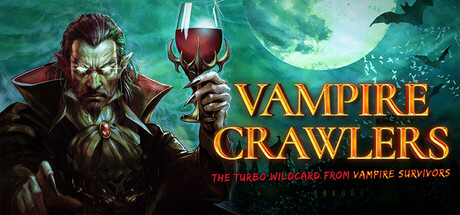
Full Name: Vampire Crawlers: The Turbo Wildcard from Vampire Survivors
Release Date: April 21, 2026
Released on: PC/Steam, Nintendo Switch, PlayStation, Xbox
Cross Play: No traditional cross play.
Initial thoughts
Every so often a game announces itself, and you already know there is danger ahead. Not danger as in this might be bad, but danger as in this is going to eat hours of our lives and we are probably going to thank it afterward. That was exactly the case with Vampire Crawlers. A new game from poncle, tied to the world of Vampire Survivors, with familiar enemies, familiar weapons, familiar faces, and a whole new dungeon crawling deckbuilding structure? Yes, that is the kind of bait that works far too well in this house.
Simone wanted this game badly, and honestly, who could blame her? Vampire Survivors already proved that poncle understands one of the most important things in gaming: making numbers go up in a way that feels deliciously stupid, chaotic, and rewarding. The original game turned simple movement and automatic attacks into a storm of upgrades, evolutions, secrets, unlocks, and screen-destroying nonsense. So when Vampire Crawlers showed up with the idea of mixing that familiar madness. To boot with a dungeon crawler and something that feels like Slay the Spire had been thrown into a coffin with garlic, bats, skeletons, relics, cursed cards, and far too many combo possibilities, the interest was immediate.
We even bought this one at full price, which is not something I say lightly when there are always review keys, bundles, discounts, and strange game deals floating around. But poncle has built a reputation for offering games that feel cheap in price but are absolutely not cheap in value. This was one of those cases where waiting felt pointless. Simone wanted to crawl through dungeons, mess with cards, destroy enemies through disgusting combos, and see how the world of Vampire Survivors would be reshaped into a different genre. So we jumped in.
And what a good decision that was.
Vampire Crawlers is not just Vampire Survivors, but cards. That would be too simple. It is more like the soul of Vampire Survivors has been squeezed into a dungeon crawler body, then given a deckbuilder brain, then fed too many relics until it started laughing at the concept of balance. It has that same addictive loop where one run becomes two, two runs become six, and suddenly you are looking at upgrades, blacksmith options, jewels, evolutions, curses, secret characters, and new strategies while pretending you are still playing just one more round.
The game is still fresh, and yes, that means there are some content limits right now. More levels, more characters, more arcanas, and more weirdness would be very welcome. But even with that said, the core of the game is already extremely strong. It is fun, clever, satisfying, and absolutely full of that classic poncle feeling where you start with a weak little plan and end with the screen begging for mercy.
Story and setting
Plot overview
The plot in Vampire Crawlers is vague, but in a very fitting way. This is not a game that sits you down for a forty minute lore lecture about ancient bloodlines, tragic kingdoms, and the emotional burden of holding too many garlic cards in your hand. It gives you a premise, a tone, a familiar universe, and then lets the chaos do most of the talking.
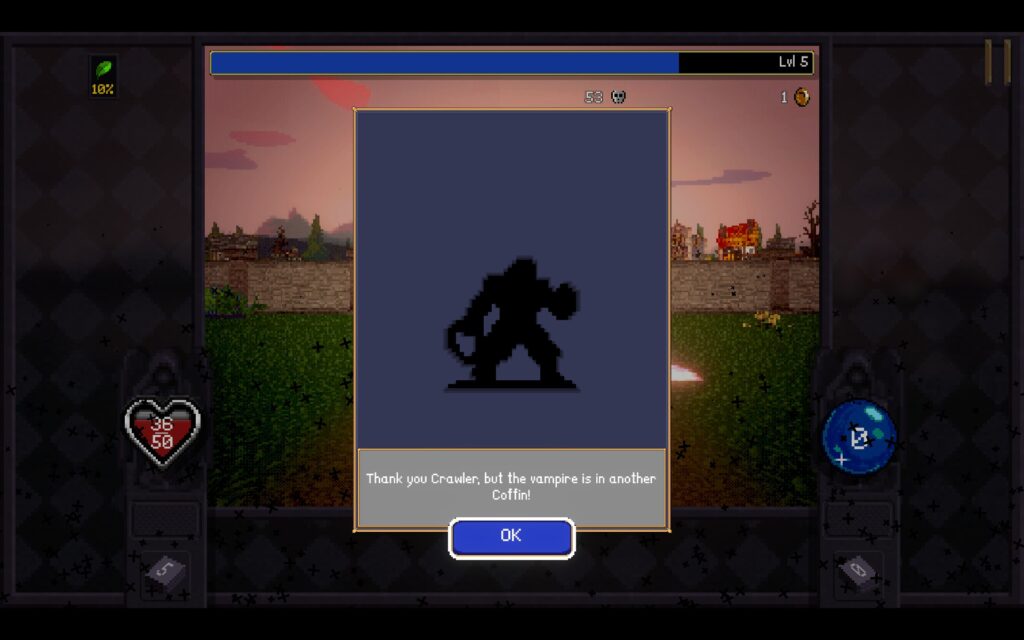
The easiest way to understand it is to imagine that this is another strange dimension of the Vampire Survivors world. Somewhere out there, beyond the usual monster filled fields and cursed libraries, there are dungeons filled with familiar horrors, coffins, strange paths, secrets, and the eternal promise that maybe, maybe this time, you will finally find the vampire. But of course, this is Vampire Survivors logic, so the vampire is always somewhere else. Another coffin. Another dungeon. Another trick. Damn it, the vampire has escaped again.
That vague structure works because Vampire Crawlers is not trying to become a story heavy RPG. It is not about deep dialogue trees or cinematic scenes. It is about the feeling of hunting something mysterious while constantly being distracted by loot, cards, relics, upgrades, and strange discoveries. The plot is more of a funny background curse than a traditional narrative. You are crawling through places that feel connected to the same weird universe, finding familiar weapons and monsters, and slowly building yourself into something far too powerful for anything nearby to reasonably survive.
There is a nice charm in how little the game explains. It trusts the player to understand the joke. If you know Vampire Survivors, you already know that the absence of a clear vampire is part of the identity. Vampire Crawlers keeps that same playful mystery alive. You search, you fight, you upgrade, you open coffins, you hope for answers, and then the game shrugs and hands you more nonsense to destroy enemies with.
That is exactly the kind of plot this game needs.
World building and immersion
The world building in Vampire Crawlers is not built through long descriptions or massive story dumps. Instead, it comes through recognition, atmosphere, systems, and the way familiar Vampire Survivors elements are reimagined in a dungeon crawler format. You see enemies you know. You see weapons and items that immediately trigger memories. You recognize the logic of evolutions. You understand that certain combinations matter because they mattered before. That gives the game a clever sense of continuity without needing to constantly point at the old game and say, Remember this?
The dungeon crawling setup gives the universe a different texture. In Vampire Survivors, you are usually out in large open spaces, moving around while enemies flood toward you. In Vampire Crawlers, the perspective changes completely. Now you are pushing through dungeon floors, moving through layered spaces, choosing routes, fighting encounters, collecting resources, and making decisions that feel more deliberate. It still has the chaotic upgrade DNA of Vampire Survivors, but the dungeon format makes it feel more strategic and contained.
That change gives the game a fresh identity. It is not just a spin off wearing familiar clothes. It actually feels like another corner of the same universe. The enemies and items are recognizable, but the way you interact with them has changed. Instead of dodging swarms in real time, you are thinking about your hand, your combo order, your mana, your relics, your card draw, and your evolved tools. And of course, how much nonsense you can stack before the enemies even get a real chance.
The world map also adds a pleasant sense of progression. You are not just selecting random stages from a flat menu. You move through areas, unlock things, dig deeper into levels, and gradually feel the game opening up. Many levels having multiple layers helps with that. It gives the impression that there is always something deeper underneath the first victory. A run is not just about surviving one fight. It is about building momentum, gathering tools, finding upgrades, and preparing to become something monstrous.
The village is one of the areas where the fresh release limitations show a little. Moving through it can feel a bit less exciting than the combat and dungeon crawling, and it would be nice if future updates made that part of the game feel richer, faster, or more filled with useful interactions. But even then, it serves its purpose as a hub where you prepare, improve, and get ready for another crawl.
The strongest immersion comes from the way the game makes you think like a greedy little combo goblin. You are not just looking at a card and asking, Does this do damage? You are asking, Can this help me pull more cards, trigger more effects, evolve into something horrible, chain into another attack, and maybe erase everything in front of me before it gets to breathe? That is where the world truly pulls you in. Not through realism, but through mechanical obsession.
Character development
Character development is not the focus here, at least not in the traditional sense. The characters are more like playstyle vessels, chaos delivery systems, and unlockable excuses to break the game in new ways. That is not a criticism. In a game like this, the important development happens through your build, your decisions, your unlocks, and your growing understanding of how to abuse the systems.
The characters still matter because they change the way you approach the game. Unlocking a new character is exciting not because you expect a giant personal drama, but because you want to know what strange advantage, limitation, or combo route they bring. The holy mother of all characters, in particular (The Red Reaper), is the kind of unlock that feels like a proper reward after pushing through the game’s tougher challenges. It gives you that classic oh, now we are doing this feeling.
The real character arc belongs to the player. You begin by making simple choices. You pick cards that seem useful. You survive. You learn. Then you start understanding item requirements, evolutions, relic synergies, draw loops, and overkill routes. By the time the game fully clicks, you are no longer just playing cards. You are constructing a machine that exists to embarrass the dungeon.
That is where Vampire Crawlers shines. It does not need deep character writing to create progression. The growth is mechanical, strategic, and personal. You become better. Your upgrades become stronger. Your card choices become smarter. Your combos become more disgusting. That is enough.
Emotional impact
Emotionally, Vampire Crawlers works through joy, surprise, and that wonderful feeling of discovering that a game is exactly the kind of nonsense you hoped it would be. It is not emotional in the tearful story sense. Nobody needs to stare into the rain while explaining the tragic past of a garlic bulb. But it does create a very real kind of happiness: the kind that comes from playing something clever, funny, addictive, and full of ridiculous escalation.
There is a special satisfaction in starting a run feeling a bit weak, uncertain, or even slightly bullied by the dungeon, then slowly putting together a strategy that transforms everything. Early on, the game can feel tough. You might not have the right cards yet. You might not understand which combinations matter. You might not have enough upgrades or relics to make your plan explode properly. But then the pieces start clicking. You get the right card draw. You evolve something important. You build a combo that keeps feeding itself. Suddenly, the enemies that used to feel threatening are being overkilled into dust.
That transformation is the emotional hook. It gives you the same kind of joy as Vampire Survivors, but in a more tactical form. Instead of watching your character become a walking blender of death, you are building a deck and a strategy that turns your turns into a crime scene. It feels earned, especially when the early difficulty made you work for it.
There is also an honest excitement in seeing familiar Vampire Survivors elements appear in a new format. When a known item, enemy, or evolution shows up, it creates that small spark of recognition. It feels like seeing an old friend in a very cursed dungeon. The game knows where it came from, and that makes it charming.
Rating for story and setting
I have visited multiple aspects of the story and after some thought and objective thinking, I rated the story and setting with an 10.
Gameplay and mechanics
Core gameplay mechanics
The gameplay is where Vampire Crawlers truly becomes dangerous. This is the part of the game that grabs your attention, steals your evening, and then acts innocent while you start another run. The best way to describe it is this: imagine Slay the Spire and an old school dungeon crawler got dragged into the Vampire Survivors universe, then someone handed them a pile of relics, evolutions, cursed combinations, and permission to become completely unreasonable.
At its core, Vampire Crawlers is about crawling through dungeon floors, fighting enemies through cards, building combos, upgrading your power after runs, and slowly unlocking more ways to become absurdly strong. You explore different areas, move through layered levels, gather cards, evolve them using familiar item logic from Vampire Survivors, and return from runs with resources that can improve your future attempts.
The mechanics are intricate without becoming impossible to understand. Early on, the game may feel rough because you do not yet have enough tools, upgrades, or knowledge. You can absolutely lose if you play without strategy. This is not a game where every card randomly works with every other card and victory just falls into your lap. You need to understand your build. You need to know when to draw, when to attack, when to stack, when to evolve, when to spend resources, and when to push deeper.
But once the game clicks, it becomes glorious.
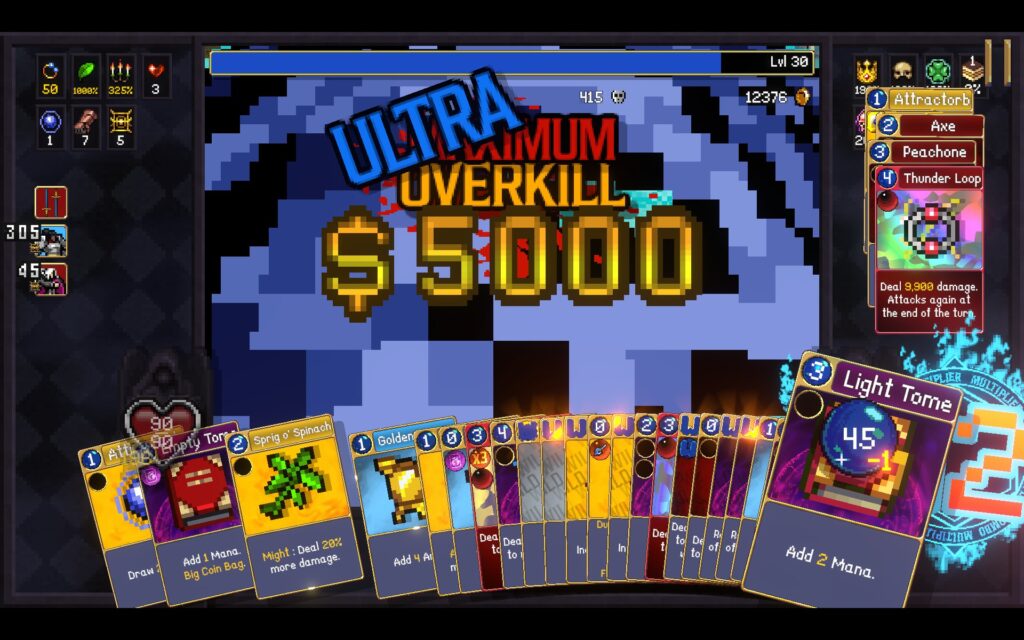
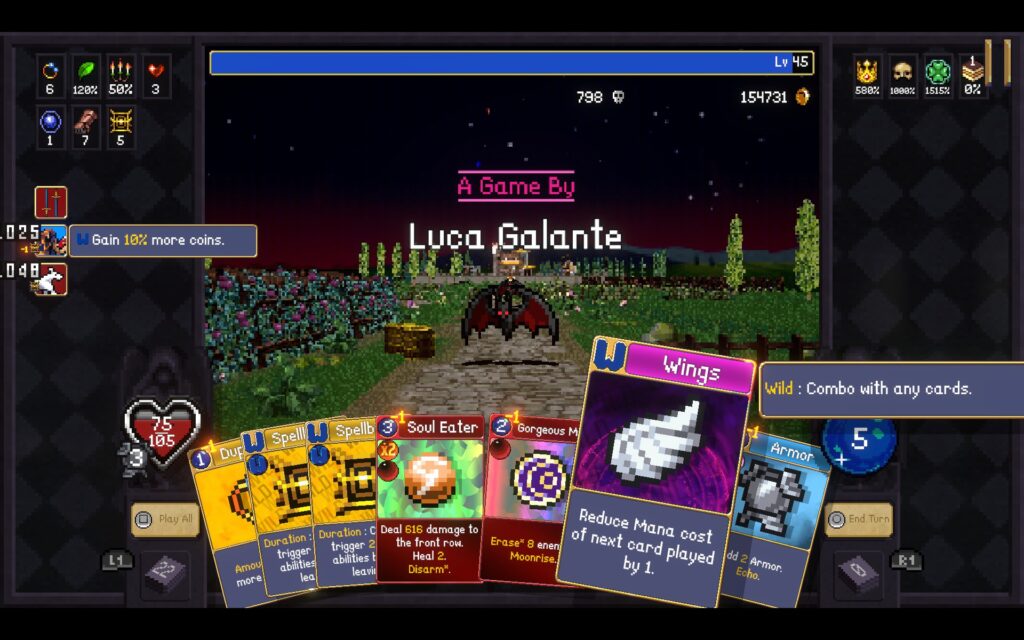
The combo system is the star. Some games give you combos that feel like small bonuses. Vampire Crawlers gives you combos that feel like you have found a loophole in dungeon law. You can create builds where cards keep pulling other cards, where effects stack, where enemies are overkilled beyond any reasonable amount. This leads to where your hand becomes less of a hand and more of a swollen fist holding fifty cursed tools of destruction. It is wonderful.
The game understands that the fun of Vampire Survivors was never just surviving. It was escalation. It was turning weak starts into unstoppable engines. It was finding combinations that made the screen melt. Vampire Crawlers captures that feeling through cards instead of automatic weapons, and that is a huge achievement.
Difficulty and balance
The difficulty is one of the more interesting parts of Vampire Crawlers. Early on, it can feel tough, and that is important to mention. This is not because the game is unfair, but because it expects you to learn its systems. If you go in thinking you can just slap damage cards around without building synergy, the dungeon will correct you.
That early toughness actually helps the game. It makes the later power spikes feel earned. When you finally build a combo that keeps drawing cards, keeps attacking, keeps stacking bonuses, and keeps deleting enemies before they can do anything meaningful, it feels amazing because you remember when the same dungeon was giving you problems.
Balance in this kind of game is tricky because part of the fun is becoming overpowered. Vampire Crawlers knows that. It does not seem afraid of letting the player create stupidly strong builds. In fact, that is one of its best qualities. The challenge is not always about preventing overpowered combinations; sometimes the challenge is finding them, surviving long enough to build them, and understanding how to use them properly.
That said, because the game is still fresh, some balance roughness is understandable. Certain strategies may feel much stronger than others once discovered. Some early runs may feel more limited before upgrades open the game up. Some areas could use more content or more variety over time. But none of that breaks the experience. If anything, it makes the game feel like a foundation that is already very good and could become even more dangerous with updates.
Pacing of the game
The pacing is addictive, though not flawless. The combat and dungeon progression are easily the strongest parts. Once you are in a run and the cards start flowing, the game has a very strong rhythm. You fight, choose, upgrade, evolve, push forward, and slowly feel your build coming together. A good run has that classic just one more floor energy.
The early game may feel a bit slower because you are still unlocking tools, learning systems, and building your permanent upgrades. That is normal for a roguelite deckbuilder, but it is worth noting. Players expecting immediate full chaos from the first few minutes may need a little patience. The real madness arrives when you understand the systems and have enough options to build something horrible.
The content pacing is also tied to the current amount of levels and characters. The game already offers a lot of fun, but once you are hooked, you naturally want more. More levels would help keep the long term pacing fresh. More characters would create more reasons to replay. More arcanas and deeper late-game options would make the already chaotic structure even better.
Still, the pacing succeeds where it matters most: the runs themselves. When you are inside the dungeon, building your engine, and watching your strategy turn from maybe this works into the enemies are no longer legally allowed to exist, the game moves beautifully.
Innovation and uniqueness
Vampire Crawlers is one of those spin offs that actually justifies its existence. It does not feel like poncle simply slapped the Vampire Survivors name onto a random deckbuilder. It feels like a genuine attempt to translate the core joy of Vampire Survivors into a different genre.
That is harder than it sounds. The original game is built around movement, enemy waves, automatic attacks, and real time chaos. Vampire Crawlers changes all of that. It becomes turn based, card driven, dungeon based, and more strategic. Yet somehow, it still feels connected. The evolutions, the familiar weapons, the enemies, the escalation, the secrets, and the absurd overkill all carry the same spirit.
The combination of dungeon crawler and deckbuilder is not entirely new, but the Vampire Survivors flavor makes it stand out. The first person dungeon crawling presentation gives it an old school feel, while the card mechanics give it modern roguelite strategy. The result is a game that feels familiar and fresh at the same time.
The most unique part is how the game handles escalation. Many deckbuilders let you build strong decks. Vampire Crawlers lets you build decks that feel like they have escaped containment. The draw loops, evolutions, relic interactions, and overkill potential make the game feel wilder than many other card-based roguelites. That wildness is exactly what it needed.
Controls and user interface
The controls are generally solid and easy to understand. The game does not need complicated inputs because most of the depth comes from decision making rather than physical execution. You are choosing cards, managing resources, navigating floors, and planning your turns. That makes it comfortable to play, especially for longer sessions.
Microtransactions
There are no aggressive microtransactions ruining the experience, and that deserves praise. This is a proper game you buy and play. That alone already feels refreshing in a world where far too many games want to sell you every tiny piece of progress, cosmetics, convenience, or artificial excitement.
Rating
After combing through many of the mechanics, the pacing and other factors of this game, I rated the gameplay and mechanics with an 10.
Graphics and art style
Quality of graphics and art direction
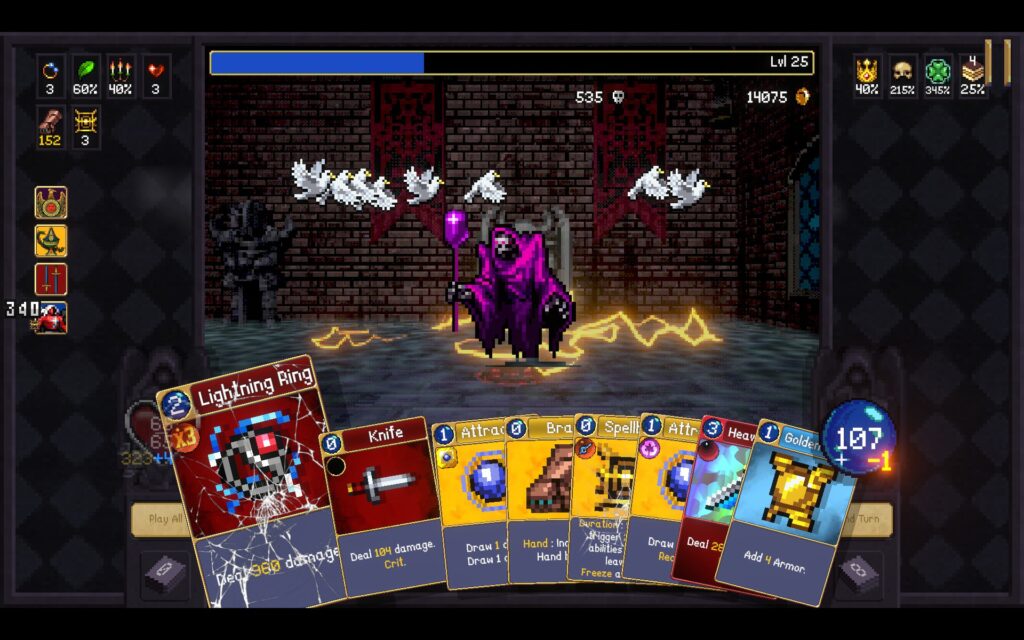
Vampire Crawlers has a great old school dungeon crawler look. It does not try to become a hyper realistic vampire simulator where every brick wall needs to show the emotional history of the masonry. Instead, it embraces a style that fits the game perfectly: clear, charming, nostalgic, and slightly ridiculous in the best way.
The art style does a good job of translating Vampire Survivors elements into this new format. Familiar enemies remain recognizable, but the change in perspective makes them feel different. Skeletons, bats, and other monsters become more direct obstacles because they are in front of you rather than swarming from every side. That makes the dungeon crawling feel more personal and immediate.
Technical performances
Technical performance was strong overall. The game ran well and kept the experience smooth, even when the combo madness started to build. That matters because a game like this needs to stay responsive. When you are drawing cards, triggering effects, evolving tools, and stacking damage, the last thing you want is for the game to choke on its own chaos.
Environment and design uniqueness
The environments work because they support the gameplay without getting in the way. The dungeons feel like places you want to push deeper into, not just decorative backgrounds. The layered level structure helps a lot. Exploring a few floors and then digging deeper gives the game a sense of descent and progress. It feels like each area has more waiting underneath it.
Rating
It took me some time to give the graphics and art style an objective rating. There are many things to consider, but ultimately, I rated this section with a 10.
Sound and music
Music score and how it contributed to the game
The sound and music are very dope. That is the cleanest way to say it. Vampire Crawlers understands that music in a game like this needs to support repetition without becoming annoying. You are going to hear tracks during multiple runs. You are going to spend a lot of time in dungeons, menus, battles, and upgrade screens. If the audio gets irritating, the whole loop becomes weaker. Thankfully, that does not happen here.
Sound effects quality
The sound effects are satisfying. They give weight to attacks, cards, rewards, and enemy destruction without becoming too noisy. In a game where combos can trigger repeatedly and effects can stack quickly, bad sound design would become a problem fast. Too much noise would turn strong builds into headaches. Too little feedback would make the cards feel weak. Vampire Crawlers finds a good middle ground.
Voice Acting
When voices or vocal touches appear, they add charm without taking over. That is the right approach. Too much voice acting could easily slow down the pace or make the game feel less snappy. Vampire Crawlers is best when it keeps you moving between decisions, fights, upgrades, and discoveries.
Rating
After a lot of consideration, I rated the sound and music section with a 10.
Replayability
Game Length and content volume
The current content is fun and worthwhile, especially for the price, but it does feel like the kind of game that will become much bigger over time. There are levels, layers, characters, secrets, upgrades, relics, evolutions, curses, and meta progression, so this is not an empty release. There is already enough here to enjoy the game properly.
However, because the game is so addictive, the limits become noticeable. More levels would help a lot. More characters would open up more run variety. More arcanas would add deeper build identity. More late game goals would keep players crawling for longer. The foundation is excellent, but the appetite it creates is bigger than the current plate.
That is not a serious flaw. It is more of a hungry compliment. Vampire Crawlers is the kind of game where finishing the available content does not make you think, Good, I am done. It makes you think, Where is the next update? Give me more cards, I have enemies to humiliate.
Extra Content
The extra content is one of the reasons the game becomes sticky. Secret characters, curses, relics, upgrades, shops, jewels, evolutions, and different combo paths all give you things to chase beyond simply clearing a stage.
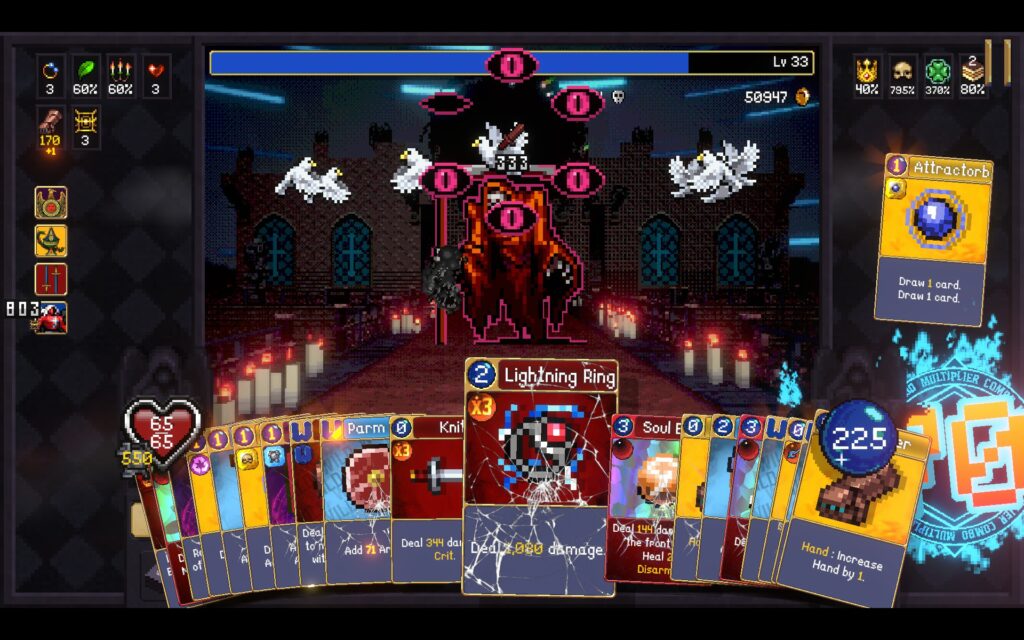
The red reaper fight was another highlight. The first time taking it down felt fantastic. It was one of those moments where the game tests whether your strategy is truly working or whether you have just been lucky. Winning there felt like proof that the combo machine had finally become powerful enough.
Replay value
The replay value comes from experimentation. You can try different card combinations, chase different evolutions, use different relics, build around different strategies, and push curses if you want more challenge. You can aim for overkill. You can buy out shops. You can improve jewels. You can unlock secret characters. You can build around revives. You can find ways to keep drawing cards and make combos that feel illegal.
That is exactly what a roguelite deckbuilder needs. Repetition only works when the player feels like each run has the potential to become something different. Vampire Crawlers provides that. Even when you know the general structure of a run, the specific cards, relics, upgrades, and choices can shift your direction.
Rating
After thoughtful consideration, I decided to rate the replayability and game length of this game with a 10.
Suggestions and comparisons
Suggestions and feedback
The biggest suggestion is simple: more. More characters, more arcanas, more levels, more relics, more secrets, more evolutions, more madness. The game already has a fantastic foundation, and it deserves to grow into something even bigger.
Comparisons
The easiest comparison is Slay the Spire, but that only tells part of the story. Vampire Crawlers has deckbuilding, card choices, synergies, and run based strategy, so the comparison makes sense. However, it does not feel like a clone. The dungeon crawling perspective, Vampire Survivors evolutions, relic madness, and familiar universe give it a very different identity.
Compared to Slay the Spire, Vampire Crawlers feels more chaotic and more focused on explosive escalation. Slay the Spire is often about careful risk management, enemy patterns, and precise deck shaping. Vampire Crawlers still has strategy, but it also loves giving you the tools to create something disgusting. It is less elegant in a traditional card game sense and more wild in that beautiful poncle way.
Compared to Vampire Survivors, this game is much more tactical. You are not relying on movement and automatic attacks. You are making direct choices, managing cards, and planning turns. But the emotional rhythm is similar. Start weak, find upgrades, evolve tools, snowball into nonsense, and eventually overkill enemies so hard that the dungeon should probably file a complaint.
It also has some old school dungeon crawler DNA. The first person movement, floor exploration, and dungeon structure give it a classic feeling that separates it from many modern deckbuilders. That combination makes the game stand out. It is not just one genre. It is several ideas stitched together into a very entertaining monster.
Personal experiences and anecdotes
Simone played Vampire Crawlers, and that made the game even more enjoyable to experience. This was not one of those cases where we picked up a game out of mild curiosity and then forgot about it after a short session. Simone genuinely wanted this one, so we bought it at full price and jumped in with proper excitement.
One of the best early highlights was taking down the red reaper for the first time. That felt like a real achievement. The red reaper is exactly the kind of enemy that makes you question whether your build is truly good enough. When you finally beat it, the game gives that satisfying feeling of, yes, the strategy worked, and yes, this dungeon is now in trouble.
And perhaps the best compliment is this: Vampire Crawlers was so good that it made us start playing another poncle game again. That is when you know a spin off did its job. It did not replace Vampire Survivors. It reminded us why that universe is so addictive in the first place, while also proving it can survive in a completely different genre.
This game was fucking good.
Rating
Taking in all the personal experiences in this game, I give it a personal rating of 10.1.
Last words
Pros
- Excellent mix of deckbuilding and dungeon crawling.
- Captures the chaotic spirit of Vampire Survivors in a new format.
- Very addictive run structure.
- Disgusting combo potential in the best possible way.
- Great feeling of escalation from weak starts to absurd power.
- Relics add strong variety to runs.
- Card evolutions are satisfying and rewarding.
- Curses add more challenge for players who want it.
- No aggressive microtransaction nonsense.
- Music and sound effects are very enjoyable.
- Good meta progression through upgrades, blacksmith options, and jewels.
- Great game to watch and discuss while someone else plays.
- Strong foundation for future updates.
- Beating major threats like the red reaper feels genuinely satisfying.
- Has that classic poncle one more run danger.
Cons
- The game currently needs more levels, characters, arcanas, and content in general.
Vampire Crawlers is a fantastic spin off and one of the most fun surprises from Poncle’s growing universe. It takes the addictive upgrade madness of Vampire Survivors, reshapes it into a turn based deckbuilding dungeon crawler, and somehow keeps the same soul alive. That is not easy. A lot of spin offs lose what made the original special, but this one understands the assignment.
The game is strategic, chaotic, funny, rewarding, and full of disgusting combo potential. It starts off a little tough, especially before you understand its systems, but once it clicks, it becomes extremely hard to stop playing. The card chains, evolutions, relics, upgrades, secret characters, curses, and overkill madness all come together into a loop that feels dangerous in the best way.
Yes, it needs more content. More levels, more characters, more arcanas, more secrets, more everything. The village could be improved, and some fresh release roughness is still there. But those complaints mostly exist because the core game is already so good. When a game leaves you saying WE NEED MORE, that is usually a sign that it has done something very right.
Simone wanted this game badly, we bought it at full price, and honestly, it delivered. Taking down the red reaper, building card draw combos, abusing revives, unlocking all characters, and watching the dungeon get completely bullied by overkill strategies made this one a blast.
Even though the game will improve and get better with updates, damn it all, this game needs a 10. But for now, until it improves, it gets a little bit lower score for the game to improve.
FINAL RATING

9.99
Please let me know what you think of Vampire Crawlers in the comments!
I hope you enjoyed reading this review, I hope to see you in the next review!
If you liked reading this review, maybe you would like to share this review with your friends.
Nice review! Reading it made me feel like I should bump this game up in priority to play.
You really should!
Solid review man. I wasn’t sure how a deckbuilder version of Vampire Survivors would play, but it sounds like they nailed the vibe. Building broken card combos and wiping the dungeon sounds pretty fun
It is indeed a lot of fun.
I see that you are trying to lure me to the dark side… when Vampire Survivors blew up, I convinced myself it was too hectic for my taste, but kept the option of trying it someday open… Now they release a deckbuilding game, a genre I like a lot, and you give it a 10.1 out of 10!
Come to the dark side…. we have lots of goodies, no vampires though.
Fatality!
Crawler wins!
Flawless victory!
All those poor mobs.
Nice game to try. The card game look solid and fun to play if i’ve i would try to play it
maybe you can try it one day.
For me looks like typical mobile game, again with “stolen” lore and aestethic from something good.
It’s not even close to a mobile game, in quality, graphics or anything other, and they stole no lore whatsoever.
I played the demo when it got announced and loved it instantly. So need to get the full game! Glad you had so much fun!
Get the full game!
one of those games I come across that I feel should have more choices like in characters, levels…etc. but overall solid game and great review.
There are already over 30 characters and nearly 20 levels, and this was just on release.
I didnt played Vampire Survivors but i played (or better said tryed) some other games from this genre. Thats not for me. Also honestly one of games reviewers which opinons i respect (but an imporant note, who specializes in strategy games and their mechanics and by himself says he dont like some other genres personally) really said how much he disliked that game recently in podcast in some longer general discussion among many different things so i now have even a bigger distrust to it 😉 BUT whole idea to move on to a card game, as suprising, was a very interesting for me from start and i was curious about this game review, i feel game might be much enjoyable when moved to this genre. I already liked a lot and enjoyed Slay the Spire and other different card games like this. More after video. PS – I like your sentance “Disgusting combo potential in the best possible way” 😀 🙂 PS2 – To not criticize too much, i heard that one of coolest mechanics is that crawlers are special cards that both give a passive and active effect and thus unlock new combo opportunities.
And you can recruit other crawlers and use their buffs as well!
Looks like a great game for any Slay the Spire enjoyers, and I love that it’s Vampire Survivors spinoff/themed, cause I really enjoyed that game.
Who doesn’t love some Vampire survivors?
Looks good
It does.
I love combos! One of my favourite things to do in MTG was make combos. Sounds extremely fun and I always loved the old school dungeon crawlers so mixing it with deck building seems perfectly natural to me as both kind of have that board game feel to them.
I also love dungeon crawlers.
I was really fascinated to know that the followup to Vampire Survivors changed up the genre and with it a fun game that expands the world of the series with a unique identity of its own 🙂
It does have a great identity.
I enjoyed Vampire Survivors, and this one looks to be another slamdunk from the developer, so I’m very interested in playing it at some point!
Great review as always! 😄
I am glad you like the review.
They clearly know how to make a roguelite game, will see if they keep releasing new content as they did with Vampire Survivors
There is already a road map, and they are following it properly.
I think perhaps more levels would be good for fans and that’s great that combos are satisfying. However vampires seems like my vibe, but generally I’m not a fan of cards games.
Maybe give it a try?
Overall, the game has an interesting mechanic that I liked right away.
Crushing your opponents?
The concept might be fun, but I’m worried this kind of game will get repetitive.
It’s too fun for that.
Not quite my type of game, not sure which one is the “least my type” out of this and the original Vampire Survivors. But you obviously had a lot of fun with it, so that’s great!
Simone and I loved it.
Poncle really knows that games are supposed to be FUN, with dopamine inducing numbers, and gameplay loop that’s super addicting, with such simplicity in mechanics, it’s amazing, i wanna try this one soon
Yep, the man knows the formula! 😀
And it’s wonderful how you can play it endlessly, without it becoming repetitive. That’s a feat that’s hard to achieve.
Also, ultra maximum overkill—the kind of fatality we just needed. XD
FATALITY!
Dopamine rush with ultra big numbers!!!!!
I will look at it after finished survivors.
Good luck with that.