
Introduction
Basic information
Developer Name: Nintendo EAD Tokyo
Full Name: Super Mario Galaxy
Release Date: November 1, 2007 originally / October 2, 2025 on Nintendo Switch bundle
Released on: Wii, Nintendo Switch, Nintendo Switch 2 compatible
Cross Play: No
Initial thoughts
My wife and I both got this game as a present for our anniversary, bought physically in a store while we were away, which already made it feel special before we even started playing. But the real emotional weight comes from the fact that Super Mario Galaxy 1 was the first game we ever played together as a couple. We are talking about roughly eighteen years ago, which is wonderful, terrifying, and slightly painful to type.
So replaying it together was not just a normal revisit. It was a memory lane explosion with gravity boots. We remembered galaxies, bosses, stars, music, frustrations, and little moments from way back then. Some stages that once gave us serious trouble were suddenly easy now, which was both satisfying and funny. It made the whole replay feel like a mix of nostalgia, skill growth, and wow, we are older now, but Mario is still jumping around like nothing happened.
The Switch version itself also makes the game more comfortable to revisit. The cleaner presentation helps, and having it bundled with Super Mario Galaxy 2 is excellent because these two games belong together. Still, while this is absolutely a brilliant game, it is not flawless. The co-op is weaker than Galaxy 2, the 100% structure is ridiculous, and whoever thought fifteen purple coin stars were a fun idea deserves to be chased by Cosmic Mario through a hallway of shame.
Story and setting
Plot overview
Of course, Princess Peach gets kidnapped again. This is Mario. Tradition demands the princess be stolen, like Bowser is filling out a yearly calendar event. But Super Mario Galaxy gives that familiar setup a much grander, more magical frame. Bowser does not just stomp into the Mushroom Kingdom and run away with Peach; he launches the whole conflict into space, turning the adventure into something cosmic, whimsical, and surprisingly emotional.
The plot itself is not complicated, but it does not need to be. Mario travels across galaxies, collects Power Stars, helps Rosalina and the Lumas, and slowly builds toward a universe sized showdown with Bowser. The story works because the tone is so strong. It makes a simple Mario rescue plot feel larger, stranger, and more heartfelt than usual.
World building and immersion
The world building is one of the game’s greatest strengths. The Comet Observatory is a beautiful hub, and each dome feels like a gateway to wonder. The galaxy structure allows Nintendo to create tiny self-contained worlds with their own mechanics, moods, and visual identities. One moment you are skating across icy planetoids, the next you are swimming through space water, walking upside down, or flying through star bits like a sugar fueled astronaut.
This is also where Galaxy 1 has a certain magic that even Galaxy 2 does not fully replicate. The sequel may improve some mechanics and co-op elements, but the first game has a stronger atmosphere and a more elegant emotional frame. The Observatory, Rosalina’s presence, and the sense of lonely cosmic travel give it a unique identity.
Character development
Mario remains Mario: heroic, cheerful, and always ready to fling himself across impossible space platforms without questioning the physics. Peach is again the goal, Bowser is again the loud problem, and Luigi eventually becomes part of the completion journey.
Rosalina is the standout. Her quiet presence gives the game a sense of mystery and dignity, and the Lumas make the world feel gentle and strange. She is one of the best additions to the Mario universe, and Galaxy 1 still handles her better than many later appearances.
Emotional impact
The emotional impact is much stronger than a Mario game usually needs to be. Rosalina’s storybook gives the game a gentle sadness and warmth that still stands out in the franchise. It never overwhelms the adventure, but it adds just enough melancholy to make the journey feel meaningful.
For us personally, the emotional impact was even bigger because of our history with the game. Replaying the first co-op game we ever played together as a couple gave the whole experience a personal layer that no technical upgrade could create by itself.
Rating for story and setting
I have visited multiple aspects of the story, and after some thought and objective thinking, I rated the story and setting with an 8.8
Gameplay and mechanics
Core gameplay mechanics
The gameplay is still fantastic. Running around small planets, shifting gravity, launching between stars, and navigating bite sized mechanical ideas remains incredibly creative. Super Mario Galaxy is one of those games where Nintendo took a simple concept, Mario in space, and then built an entire physics playground around it.
On Switch, the controls are mostly neat, though pointing with the Pro Controller felt weird at the beginning. The original Wii pointer setup was clearly baked deeply into the game’s design, so adapting that to modern controls works, but it takes adjustment. Once it clicks, though, collecting star bits, aiming, spinning, and navigating galaxies feels smooth enough.
The co-op, however, is limited. The second player can help collect star bits, stun enemies, and assist a bit, but compared to Super Mario Galaxy 2, it feels much weaker. Galaxy 2 gives the second player more meaningful control and interaction, which makes it the better co-op experience. For a game that means so much to us as our first shared co-op memory, it is funny that the co-op itself is not the strongest part mechanically.
Difficulty and balance
This is where Galaxy 1 still shines compared to Galaxy 2. The difficulty curve is beautifully balanced. It starts approachable, slowly introduces more complex ideas, and then adds sharper spikes without becoming too chaotic too early. It has challenge, but the structure feels carefully guided.
Galaxy 2 may have more advanced ideas and better co-op, but it sometimes misses the elegant difficulty balance of the first game. Galaxy 1 feels smoother, more graceful, and more deliberate in how it raises the pressure.
That said, the purple coin missions. Holy fuck. Some are fine. Some are even decent. But fifteen purple coin stars? Really? That is where the game starts pushing past fun challenge into who hurt you, Nintendo?
Pacing of the game
The pacing is excellent during the main adventure. Galaxies are short enough to keep things moving but dense enough to feel memorable. The game rarely wastes time, and most stars introduce a clear idea, develop it, and move on before it becomes stale.
The pacing only gets worse during completion. Having to play the entire game again as Luigi for 100% is a wild decision. It adds replay value on paper, but in practice it asks players to redo a lot of content they just finished. That is not elegant completion design. That is a cosmic endurance test wearing green overalls.
Innovation and uniqueness
Even today, Super Mario Galaxy feels wildly inventive. Gravity based platforming, spherical worlds, tiny planets, and creative star objectives give it a timeless identity. It does not feel like Mario, but in space as a gimmick. It feels like the team rebuilt 3D Mario around the concept properly.
This is why the game still holds up. The central idea is not only clever; it is fully explored.
Controls and user interface
The UI is clean and readable, and the Switch version does a good job modernizing the experience without ruining it. Nintendo’s updated bundle also includes improved UI and Switch 2 visual enhancements, making the package more comfortable for modern play.
The pointer adaptation is the one part that feels a bit awkward at first. It is not bad, but it reminds you constantly that this was originally built around Wii hardware.
Microtransactions
None. Just stars, pain, purple coins, and the eternal question of why Luigi must suffer through the whole universe again.
Rating
After combing through many of the mechanics, the pacing, and other factors of this game, I rated the gameplay and mechanics with an 8.7.
Graphics and art style
Quality of graphics and art direction
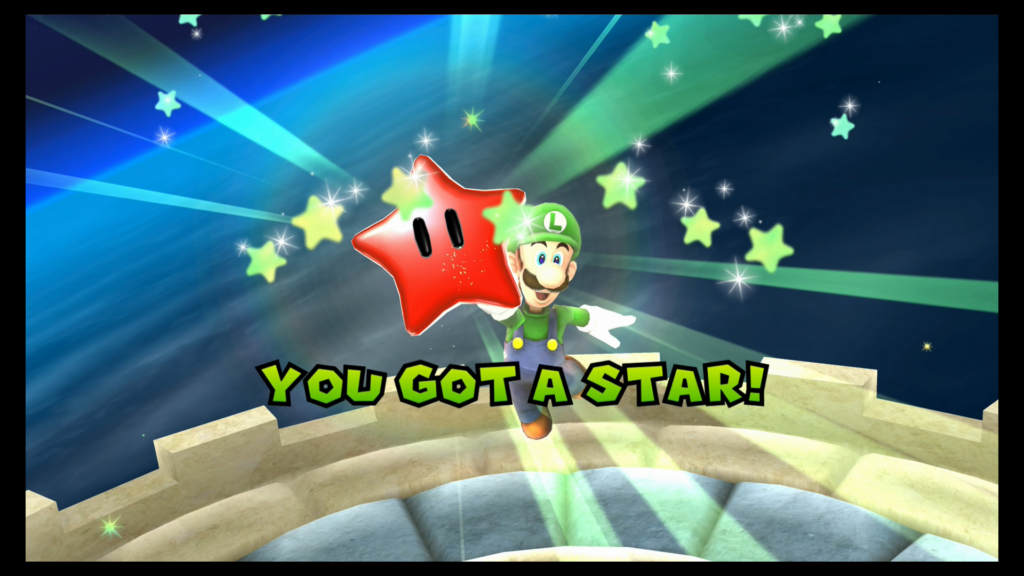
The game looks much improved compared to the original Wii version, even if the upgrade is mostly resolution and presentation rather than a full remake. The art direction was already so strong that it did not need a complete overhaul. Bright colors, clean shapes, expressive characters, and dreamlike galaxy themes all still look fantastic.
This is one of those games where strong art direction beats raw technical power. The Switch version simply lets that original art breathe more clearly.
Technical performances
Performance is strong, and the game feels smooth. That matters a lot for precision platforming because the entire experience depends on movement feeling reliable. Nintendo’s Switch bundle and Switch 2 update help present the game in a cleaner, sharper way, with official support for higher resolution on Switch 2.
Environment and design uniqueness
The galaxies are still brilliant. Each one has its own hook, whether it is gravity puzzles, swimming, floating platforms, haunted mansions, lava worlds, toy worlds, or tiny planets with weird mechanics. The variety is outstanding.
This is also why the game remains so replayable despite some completion frustration. Even after many years, individual galaxies still have enough identity to be instantly recognizable.
Rating
It took me some time to give the graphics and art style an objective rating. There are many things to consider, but ultimately, I rated this section with a 9.3.
Sound and music
Music score and how it contributed to the game
Frigging, it’s-a me, Mario! And somehow also one of Nintendo’s most majestic soundtracks. The orchestral music gives Galaxy a grandness that few Mario games had before it. The soundtrack makes space feel magical, lonely, exciting, and heroic all at once.
The music is a huge part of why this game still feels special. It does not just accompany the adventure. It elevates it.
Sound effects quality
Sound effects are classic Nintendo polish. Star bits, jumps, spins, launch stars, enemies, coins, and transformations all sound instantly readable and satisfying. The audio feedback helps make every action feel playful.
Voice Acting
There is not much traditional voice acting, but the character sounds work perfectly. Mario’s little noises, Bowser’s booming energy, Rosalina’s calm presence, and the Lumas’ charming sounds all support the tone without needing full dialogue.
Rating
After a lot of consideration, I rated the sound and music section with a 9.5.
Replayability
Game Length and content volume
The content volume is strong. There are plenty of galaxies, stars, hidden challenges, comet missions, purple coin missions, and late game goals. For the main run, the length feels excellent. It gives enough without overstaying.
For full completion, though, the game pushes too far. The repeated run and purple coin stars can turn joy into exhaustion. A game can be brilliant and still ask too much from completionists.
Extra Content
The Luigi run is the big extra content, alongside comet challenges and full star collection. It is substantial, no doubt. The problem is whether it is fun enough to justify its size. Sometimes yes. Sometimes absolutely not.
Replay value
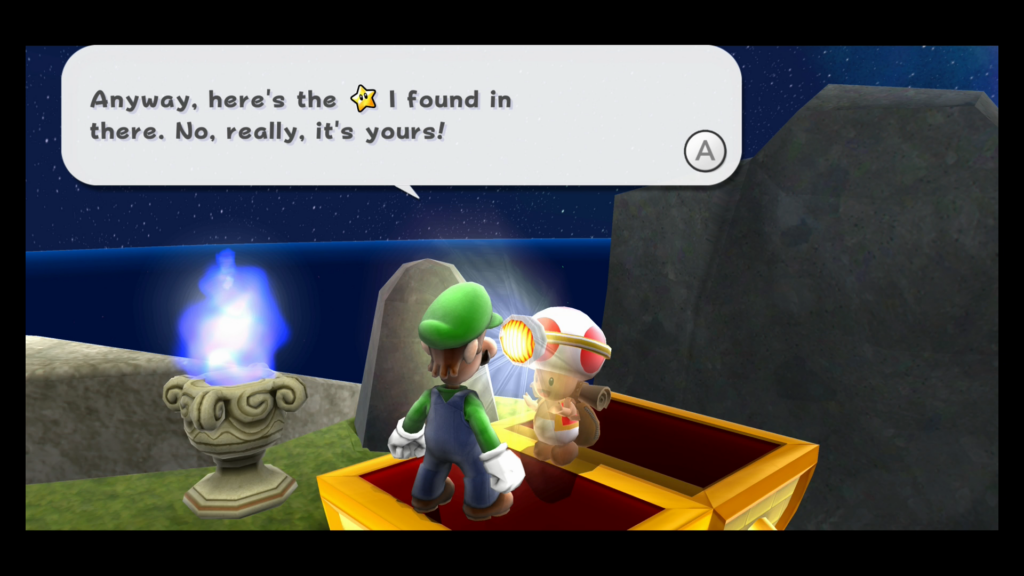
Replayability is high, partly because the game is excellent and partly because Nintendo basically forces you to replay it if you want true 100% completion. Beating the game once is not enough. You need to complete it again as Luigi, which is both cool in concept and slightly insane in practice.
Luigi controls differently enough to make the second run feel somewhat distinct, but not enough to fully justify doing everything again unless you are committed. Yes, we completed this run as well. It is replayability by design, but also replayability by cosmic threat.
Replay value is excellent for nostalgia, casual revisits, and people who love 3D Mario. For 100% completion, replay value becomes more complicated. The game is absolutely worth replaying, but maybe not always worth fully exhausting.
Rating
After thoughtful consideration, I decided to rate the replayability and game length of Super Mario Galaxy with an 8.
Suggestions and comparisons
Suggestions and feedback
They could have added stronger co-op elements from Super Mario Galaxy 2 into this version. Even a slightly more active second player role would have made the anniversary replay even better. The foundation was already there, and the sequel proved it could be improved.
The 100% structure should also have been adjusted. Playing everything twice is too much. Luigi mode is a fun reward, but full completion should not demand that level of repetition. And please, fewer purple coin stars. Fifteen is not a celebration. It is a spacetax.
Comparisons
Compared to Super Mario Galaxy 2, the first game has a better atmosphere, a stronger emotional tone, and a smoother difficulty curve. Galaxy 2 has better co op, more mechanical variety, and often sharper level ideas, but it lacks some of the first game’s elegance.
That is why we need Super Mario Galaxy 3 with the best of both. Give us Galaxy 1’s atmosphere and balance, Galaxy 2’s co-op and variety, and absolutely no requirement to beat the entire game twice unless someone at Nintendo personally mails us a cake.
Personal experiences and anecdotes
The best part of this replay was reliving the first game we ever played together as a couple. That alone made it special. Some games are good because of design. Some games are good because of memories. Super Mario Galaxy is both.
We recognized most levels immediately, and the funny thing was seeing how much easier some previously difficult stars felt now. Levels that once caused serious struggle became smooth clears. That made the replay feel like proof of how much time had passed, but also how well the game still holds up.
Some glitches have been fixed, and the presentation is cleaner, but the heart of the experience is still there. Mario still jumps through space. We still laughed. We still groaned at purple coins. And somehow, eighteen years later, the game still had that same spark.
Rating
Taking in all the personal experiences with Super Mario Galaxy, I give it a personal rating of 9.
Last words
Pros
- Still one of the best 3D Mario games
- Beautiful cosmic atmosphere
- Excellent difficulty balance
- Incredible soundtrack
- Creative galaxy design
- Switch version looks much cleaner
- Strong nostalgia factor
- Rosalina and the Lumas add emotional depth
- Fantastic main game pacing
- Great bundled value with Galaxy 2
- Still fun to replay together
Cons
- Co-op is weaker than Galaxy 2
- Pointer controls feel odd with Pro Controller at first
- 100% completion requires beating the game twice
Super Mario Galaxy is still magical. The Switch version makes it easier and cleaner to revisit, and playing it again with my wife gave it an extra emotional layer because this was the first game we ever played together as a couple. That kind of nostalgia is powerful, but the game also earns its praise through excellent design, music, atmosphere, and creativity.
Still, it is not perfect. The co-op is limited compared to Galaxy 2, the 100% requirements are ridiculous, and the purple coin missions can go launch themselves into a black hole.
Even with those issues, this remains one of Mario’s greatest adventures.
FINAL RATING

8.6
Please let me know what you think of Super Mario Galaxy in the comments!
I hope you enjoyed reading this review. I hope to see you in the next review!
If you liked reading this review, maybe you would like to share this review with your friends.
Waahoooooo!!!!!I It’za me! This is one of the best Mario games would say but like many of them not worth doing 100%
or 200%?
Another great Mario game, when it came out looked like something new that was well done
It still looks great!
Wow! Its an wonderful review. I usually doesnt rrad review but your reviews are so detalied i have read it completely the story behind the game is awesome. Hope u guys play more games together 😅
In the twenty years I know my wife, we have played a lot of co-op games!
That’s a nostalgic title I remember playing the original version with my family too.
The Switch version looks great as well, seeming to add some extra elements while keeping what made the original good!
Nintendo is good at that!
Another Mario but with him going through the universe this time. May the star bless Mario and his team.
Or Rosalina?
Imo one of the bests Mario games.
Been waiting for 10 years for a new 3D mario.
It must be big emotional jouney getting back together into this game. Game looks really nice, i though it is old so it wont look so good (but i still often like old school graphics 😉 ) but it is positive suprise, a lot of nice climat too. Not my platform/hardware so i never played it. PS – If it was this Mario game I may had guessed a wrong game title in screenshot guess on server 😉
It looks pretty good for an old game.
Ah, forced 2nd playthrough… I hate such games…
Can indeed be annoying.
It’s undoubtedly one of the best Nintendo games on the Switch.
There are other great games as well.
Might be they thought that if 2 people were playing it then the other player might want to play through being in control of the main character and the other one do the support role the second time around. But would have been more fun if it was Peach as the main character and Mario was captured XD
It is chaos in Super Mario Wonder with more people on the screen.
Every time I see a new Mario game in 3D I am amazed how they managed to make the transition from 2D so well and really use the possibilities. (I whish they would give their other franchises the same love and energy… 😬)
We need Pikmin 5!
voice acting: “YAHOOOOO”
sounds very nice with this coop background story 🙂
that is indeed unbeatable.
(and now I understand what the 200% from my youtube question is 🙈)
YAHOOOO!!
A great review! I strongly agree with the point made about a brilliant game requiring but still asking too much from completionists where repeated playthroughs may end up feeling perfunctory rather than rewarding
Too much for achievements!
A game that was revolutionary in its day and still brings back fond memories!
They need a Super Mario Galaxy 3!
A nice game with no micro transactions, a strong soundtrack and a story book from Rosalina to go along.
Indeed, a great game!
It’s all the more sweet when a great game is attached to a great memory!
Great review as always! 😁
Memories make a game great!
I remember playing quite a bit of this. Was fun! 😀
It is indeed a fun game!
Overall, the game turned out to be good, in principle, Nintendo has never had any bad Mario games. If my memory serves me right.
In the beginning they hade some flops like, Mario is missing.
Super Mario Galaxy was an instant classic, and it’s great to see Nintendo still supporting it, bringing it to the new systems so people can still enjoy it.
Gotta do that with more games!
That got me. XD
By the way, what are the purple coin stars about? I can’t recall anything about it from the Mario games I played.
Basically to collect 100 purple coins, often within a very stressful time limit, or a lot of ways to die and you need to start over completely.
I can see why it’s not your favorite activity. XD
Sounds like some achievement-hunting thing that exists just to have a trophy. I wouldn’t bother dealing with that, not even at the back of my head.